
Harmon County Arrest Records and Court Charges
A Harmon County arrest record is the account of an arrest itself. It shows who was taken into custody, the date of booking, the arresting agency, and the charges listed at the time of the arrest. That side of the record sits with the Harmon County Sheriff's Office and the county jail. An arrest, on its own, is only the start. Once a person is booked, the case passes to the District Attorney, who decides which formal charges to file with the Court Clerk. Those filed charges, not the booking entry, form the court charge record.
The two records are easy to confuse, so it helps to keep them apart. The arrest and booking detail lives on the jail roster, and you can review the custody side through the Harmon County inmate records page. The court charge record is what the prosecutor actually filed, and it is tracked case by case in the District Court system. Court charges after arrest can differ from the charges first listed at booking. The full case file, with pleas, hearings, and the final outcome, sits under criminal court records.
The Arrest and Booking Side of a Harmon County Record
The arrest side of the record begins with the Harmon County Sheriff's Office, led by Sheriff Deakon Wood. The office and county jail sit at 105 W. Jones in Hollis, with a main line of 580-688-3306. When deputies book someone, the jail roster lists the booking date and the charges entered at that point. Those roster charges are arrest charges. They reflect what an officer believed at booking, not the prosecutor's final filed counts.
The Sheriff's Office posts its address, administration hours, and main contact line on its official contact page.
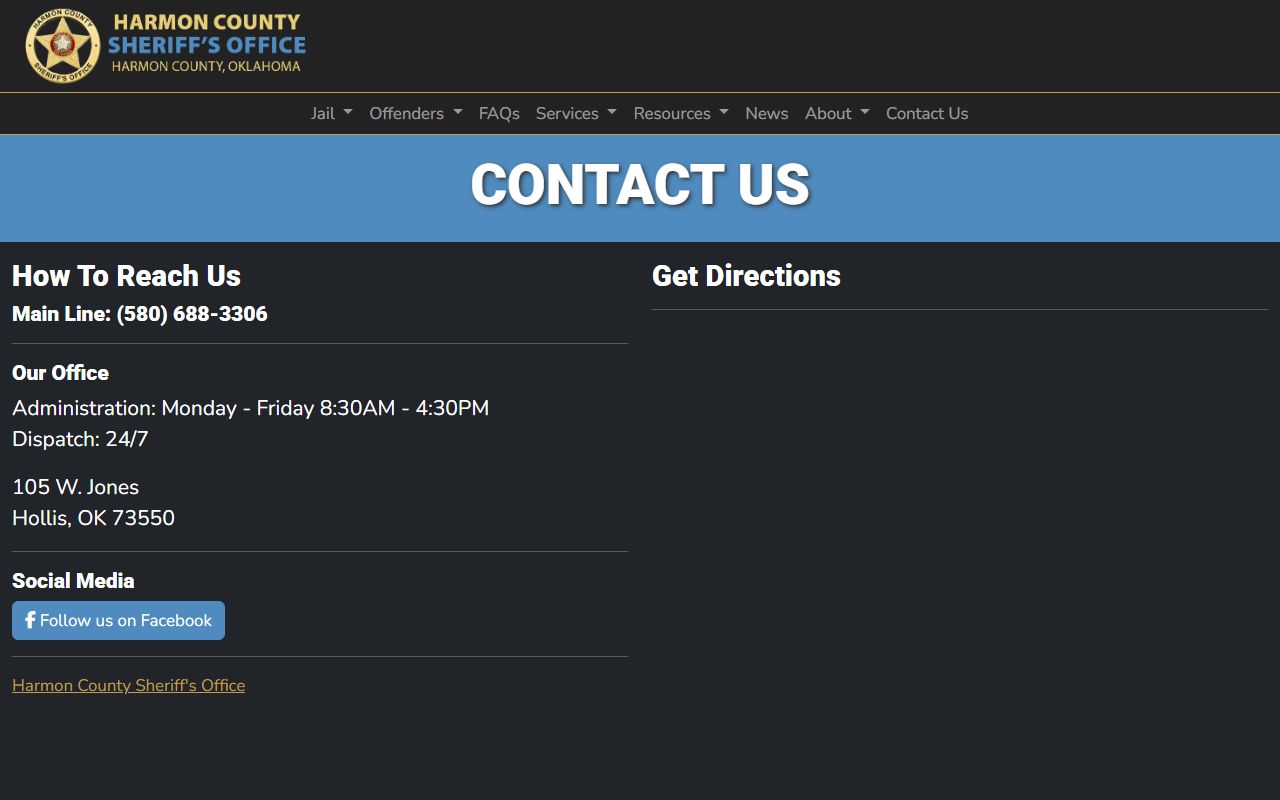
That contact page is the right first stop for questions about an arrest, a booking, or how to reach the jail in Hollis. Booking charges can still change after this point. The District Attorney may file the same counts, add counts, reduce them, or decline to file at all. For the live custody list and booking detail, the county jail roster is the better tool, while the court charge record shows what the prosecutor put before the court.
How to Find Harmon County Arrest Records and Charges
Most Harmon County court charges are searched online through two public systems. On Demand Court Records, known as ODCR, covers Harmon County District Court, with records reaching back to August 3, 2002 and updates processed hourly. The Oklahoma State Courts Network, or OSCN, offers a statewide case-number lookup that includes Harmon County. Both are free to use. Neither posts the official certified file, so the Court Clerk remains the source for certified copies.
- Open ODCR and choose Oklahoma District Courts, then narrow to Harmon County to limit the results.
- Search by defendant name in Last, First format, or enter a full case number if you already have one.
- Open the case to read the charge list, where each count appears with its offense title and statute.
- Check each charge's code, severity level, and current status, since counts shift as the case moves.
If you only have a case number, the OSCN docket search is quick. Oklahoma case numbers use prefixes such as CF for felony, CM for misdemeanor, and TR for traffic. The booking side, with arrest and custody detail, stays on the jail roster rather than the court index.
Note: Online dockets are search aids, and the official charge record should be confirmed with the Harmon County Court Clerk at 580-688-3617.
Requesting Harmon County Arrest Records From the Sheriff
Some arrest details never reach the court index. Booking reports, incident reports, and similar law enforcement files are held by the Sheriff's Office, not the Court Clerk. The Sheriff's Records Division handles those open records requests through an online form rather than the case search portals.
The office runs its open records requests through a dedicated records request page.
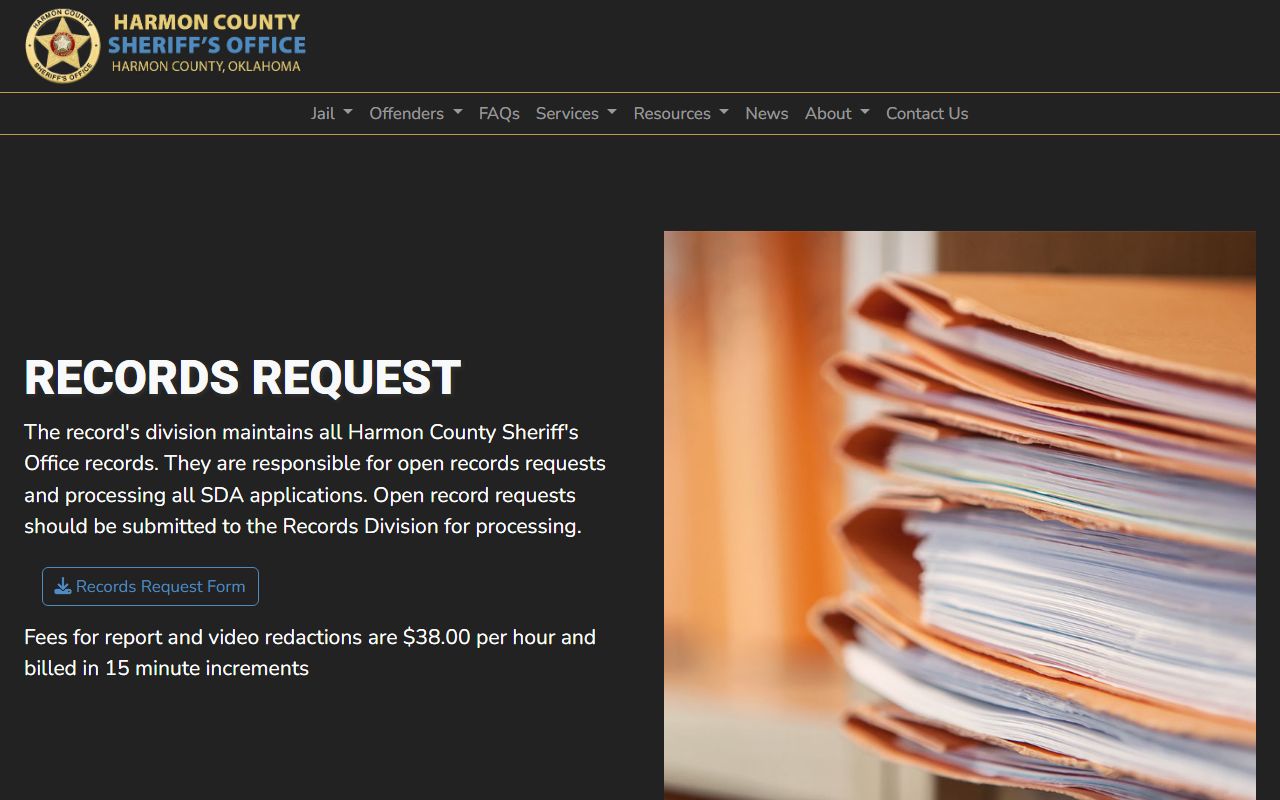
Through that page, a requestor describes the record sought, and the office responds under the Oklahoma Open Records Act. Redaction of reports and video carries a fee of $38.00 per hour, billed in 15-minute increments. The office tells each requestor the exact cost before any money is due, so no payment should be sent in advance. Active law enforcement records may be withheld or limited while a case is still open.
How Charges Get Filed After an Arrest in Harmon County
The court charge record starts when the prosecutor files a charging document. In Oklahoma, three documents can open a criminal case. A complaint is a sworn accusation, an information is the prosecutor's formal charge, and an indictment comes from a grand jury. Most Harmon County felonies proceed by information after a preliminary hearing tests probable cause, while a grand jury indictment is reserved for some serious matters.
| Complaint | Information | Indictment | |
|---|---|---|---|
| Filed By | Officer or prosecutor | District Attorney | Grand jury |
| Common For | Misdemeanors | Many felonies | Serious felonies |
| Probable Cause Tested By | Judge at first appearance | Preliminary hearing | Grand jury vote |
| Starts | The case | The case | The case |
Each filed charge is a separate count. A single arrest can lead to one count or to several, based on what the District Attorney chooses to file.
Charge Status and What It Means
Charges rarely stay frozen. As a case develops, a count can be amended, reduced, added, dropped, or dismissed. The status shown next to each charge tells you where that count stands right now, and it can change between hearings.
| Status | What It Means |
|---|---|
| Pending | The charge is filed and active, with no final outcome yet. |
| Amended / Reduced | The prosecutor changed the charge, often to a lesser offense or a corrected count. |
| Dismissed | The court ended the charge. With prejudice it cannot be refiled; without prejudice it may return. |
| Nolle Prosequi | The prosecutor formally chose not to pursue the charge. |
Charges vs. Convictions
Being charged is not the same as being convicted. A charge is an accusation that the case has begun. A conviction is the outcome, reached only by a guilty plea, a no-contest plea, or a verdict. A person can be charged and later cleared, yet the charge can still appear in the record.
| Charge | Conviction | |
|---|---|---|
| Stage | Accusation | Verdict or plea |
| Burden of Proof | Probable cause | Beyond a reasonable doubt |
| Who Decides | Prosecutor | Judge or jury |
| Public Record | Yes | Yes |
Harmon County Charge Codes and Severity Levels
Every filed charge ties to a statute. The charge record lists the offense title and the Oklahoma statute section the count rests on. Severity sorts charges into felonies, which carry the most serious penalties, and misdemeanors, which are lower-level offenses. Some matters are handled instead as municipal ordinance violations through the Hollis Municipal Court, and those may not appear in District Court searches.
One arrest can produce several coded charges at once. Reading the codes helps explain why a booking list and a filed charge list may not match.
- Count
- A single, separate charge within a criminal case.
- Information
- The prosecutor's formal written charge that opens many cases.
- Statute
- The Oklahoma legal section the charge is based on.
- Disposition
- The outcome of a charge or the whole case.
Who Files Harmon County Court Charges
The District Attorney for Oklahoma's 3rd Prosecutorial District files state criminal charges in Harmon County. District Attorney Dan Jacobsma leads the office, and Assistant District Attorney Kelissa Sanders handles local matters. The Harmon County DA office is at the courthouse, 114 W. Hollis in Hollis, phone 580-688-9459, fax 580-688-2775.
The DA's filed charges, not the jail's booking list, are the official court charges. The prosecutor reviews the arrest, the reports, and the evidence, then decides which counts to file. That is exactly why arrest charges and court charges can differ. More detail on the office sits on the state District Attorney District 3 page.
Statewide Charge and Criminal History Lookups
A county search shows one county's cases. A statewide criminal history pulls charges from across Oklahoma. The Oklahoma State Bureau of Investigation, OSBI, maintains the statewide criminal history record and processes name-based and fingerprint-based requests for a fee. OSBI is also the agency that handles arrest-record expungement, which can seal a qualifying arrest record. OSBI charges $150 to process an arrest-record expungement, while sealing the court record can be free. The agency explains both paths on its criminal history and expungement page.
Important: This site is not a consumer reporting agency under the Fair Credit Reporting Act, and its information cannot be used for employment, tenant, or credit screening.
Sealed vs. Expunged Charge Records
Oklahoma treats sealing and expunging differently, and the difference matters for charge records. A Section 991(c) expungement applies after a deferred sentence and updates the disposition to show a not-guilty plea and a dismissal, but it leaves the arrest record in place. A Section 18 expungement can remove the full arrest record for people who qualify.
| Sealed | Expunged | |
|---|---|---|
| Visibility | Hidden from public view | Treated as though it never existed |
| Law Enforcement | Limited access | Very limited access |
| Eligibility | Section 991(c) after a deferred sentence | Section 18 for qualifying arrests |
Restricted Charge Records in Harmon County
Not every charge record is open to the public. Juvenile charges are generally confidential. Sealed and expunged charges drop off the public docket once an order is entered. Some pending or dismissed matters may be limited while an investigation continues.
Court rules also keep certain identifiers out of online view. Social Security numbers, financial account numbers, full dates of birth, and similar personal data are withheld from internet-viewable filings under Oklahoma Court of Criminal Appeals Rule 2.6. For a restricted file, the Court Clerk reviews each request and may require proof of authority or a court order.
Note: A dismissed charge can still appear in older records until it is sealed or expunged through the proper District Court process.