
How to Search Harmon County Traffic Court Records
Most Harmon County traffic cases that reach the District Court show up online. The two free state systems are On Demand Court Records, known as ODCR, and the Oklahoma State Courts Network, or OSCN. ODCR lists Harmon County as a participating court, with records going back to August 3, 2002 and updates processed hourly. District traffic matters carry a TR prefix on the case number. The search returns the citation, the charge, court dates, and the disposition once the case is closed.
Have your details ready before you start. A citation number gives the cleanest match. A driver name in Last, First format also works, along with the filing date or the case type. Online data can lag or leave out documents, so the Court Clerk holds the official file.
- Open ODCR and choose Oklahoma District Courts, then pick Harmon to narrow the search to this county.
- Enter the citation or case number, or type the driver name in Last, First format.
- Set the case type to Traffic Tickets, and add a filing date range if the name returns many matches.
- Open the case to read the charge, court date, plea, fine, costs, and any warrant or payment entries.
- Pay an eligible balance, plan a court appearance, or call the Court Clerk for a certified copy.
To pay an undisposed citation, the same case is reached through the OSCN e-payments search. The search form takes a county and a case, citation, or payment plan number.
The OSCN e-payments search page lets a driver pull a Harmon County citation by number before paying.
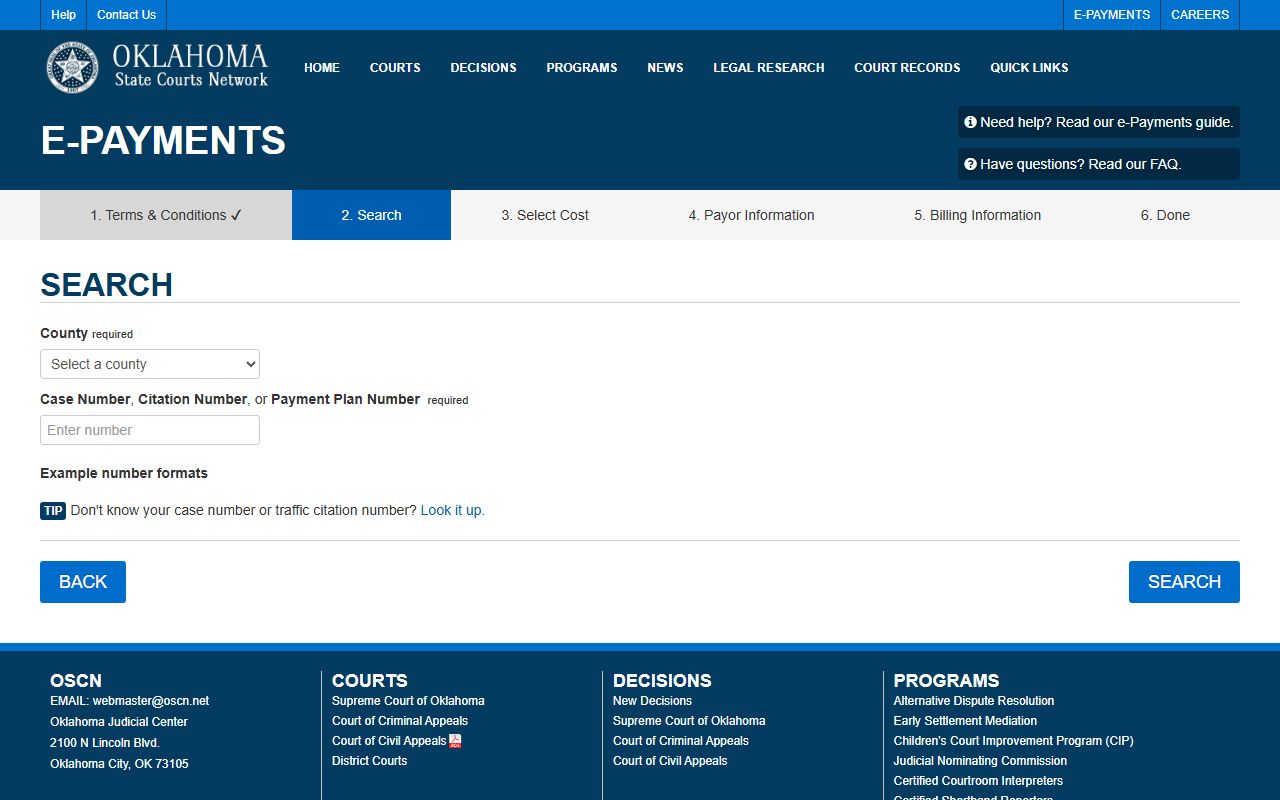
That single field accepts a full case number, a traffic citation number, or a payment plan number, so it doubles as a quick way to confirm a ticket exists in the state system before you decide to pay or appear.
Which Courts Handle Traffic Cases in Harmon County
Two courts can hold a Harmon County traffic case. The Harmon County District Court hears state traffic charges filed at the county level. The City of Hollis Municipal Court hears tickets written under city ordinances. The split matters because a municipal ticket may never appear in a District Court search.
District traffic cases are the ones you find in ODCR and OSCN as TR matters. Hollis city tickets run through the municipal court created by Chapter 13 of the city code. That court has its own clerk, its own Traffic Violations Bureau, and its own payment counter. If a search of the state systems turns up nothing, the ticket may be a city case instead.
| Court | Traffic Cases Handled | Address |
|---|---|---|
| Harmon County District Court | State traffic charges filed as TR cases, searchable in ODCR and OSCN | 114 W. Hollis, Hollis, OK 73550 |
| Hollis Municipal Court | City ordinance traffic tickets under Chapter 13, including bureau-payable citations | City of Hollis, City Clerk system |
Note: The Harmon County Court Clerk, Stacy Macias, at 580-688-3617, can confirm whether a citation is a District Court case before you spend time searching the wrong system.
Types of Traffic Cases on Record
Traffic records cover more than speeding. The District Court file may hold any moving or non-moving violation charged by the state, while the city bureau handles ordinance offenses. The categories below show the common types that land in a Harmon County record.
- Moving violations - speeding, running a signal, improper passing, and similar driving offenses charged as TR cases.
- Non-moving violations - registration, insurance, equipment, and license-display problems.
- City ordinance tickets - Hollis municipal citations payable through the Traffic Violations Bureau when they qualify.
- Commercial vehicle offenses - violations tied to a commercial driver license that carry stricter handling.
- Serious traffic crimes - driving under the influence and similar charges that route to the criminal side of the District Court.
What Harmon County Traffic Court Records Show
A District Court traffic record is built from the case docket. The fields below come from the ODCR and OSCN sample case layouts. Together they tell you what the driver was charged with, when the case was heard, and how it ended. Money owed and any warrant entries appear in the same file.
| Field | What It Shows |
|---|---|
| Citation / Case Number | The TR case number tied to the ticket, used to track and pay the case. |
| Charge / Statute | The offense title and the statute or ordinance section allegedly violated. |
| Court Date | The initial appearance date and any later hearing settings. |
| Plea | Guilty, not guilty, or nolo contendere entered by or for the driver. |
| Disposition | The outcome of the case, such as a finding, dismissal, or deferred result. |
| Fines and Costs | The fine, court costs, amount owed, receipts, and any payment plan. |
| Warrant / FTA Entries | Failure-to-appear notes and any warrant issued, recalled, or served. |
Online dockets are a search aid, not the official record. OSCN warns that its posted data is not the official file and should be confirmed with the record keeper. For anything used in court, the certified copy comes from the Court Clerk.
Searching by Citation Number vs by Name
Two ways into a traffic case exist, and each has a best use. A citation or case number points straight to one record. A name search casts wider and can return several people, so add a date range to narrow it. The OSCN e-payments search asks for a county and a single number that may be a case, a citation, or a payment plan.
| Search Field | Type | Required | Notes / Format |
|---|---|---|---|
| County | Dropdown | Yes | Select a county; Harmon appears in the county list. |
| Case, Citation, or Payment Plan Number | Text | Yes | Examples: CM-2017-100; PP-OK-2019-25; traffic citation M972124. |
| Search | Button | n/a | Runs the payment search and returns the matching balance. |
A common slip is a mistyped citation number, which returns nothing. Another is a name search that finds the wrong person who shares a name. When in doubt, the citation number wins.
Paying or Contesting a Harmon County Traffic Ticket
Paying a District Court citation online runs through OSCN e-payments, but the rules are strict. An undisposed traffic citation can be paid only when the driver enters a guilty or nolo contendere plea, pays the amount due in full, and pays on or before the Initial Appearance Date. Paying that way enters a plea, so it ends the case rather than fighting it.
Older closed cases can be different. Disposed CF, CM, TR, and WL cases may be payable if all counts are fully disposed after January 1, 2005 and a balance remains. Payments can take 24 to 48 hours to appear, and a new case may not show up right away.
The OSCN e-payments terms and eligibility page spells out which Harmon County citations can be paid online and what a plea means.
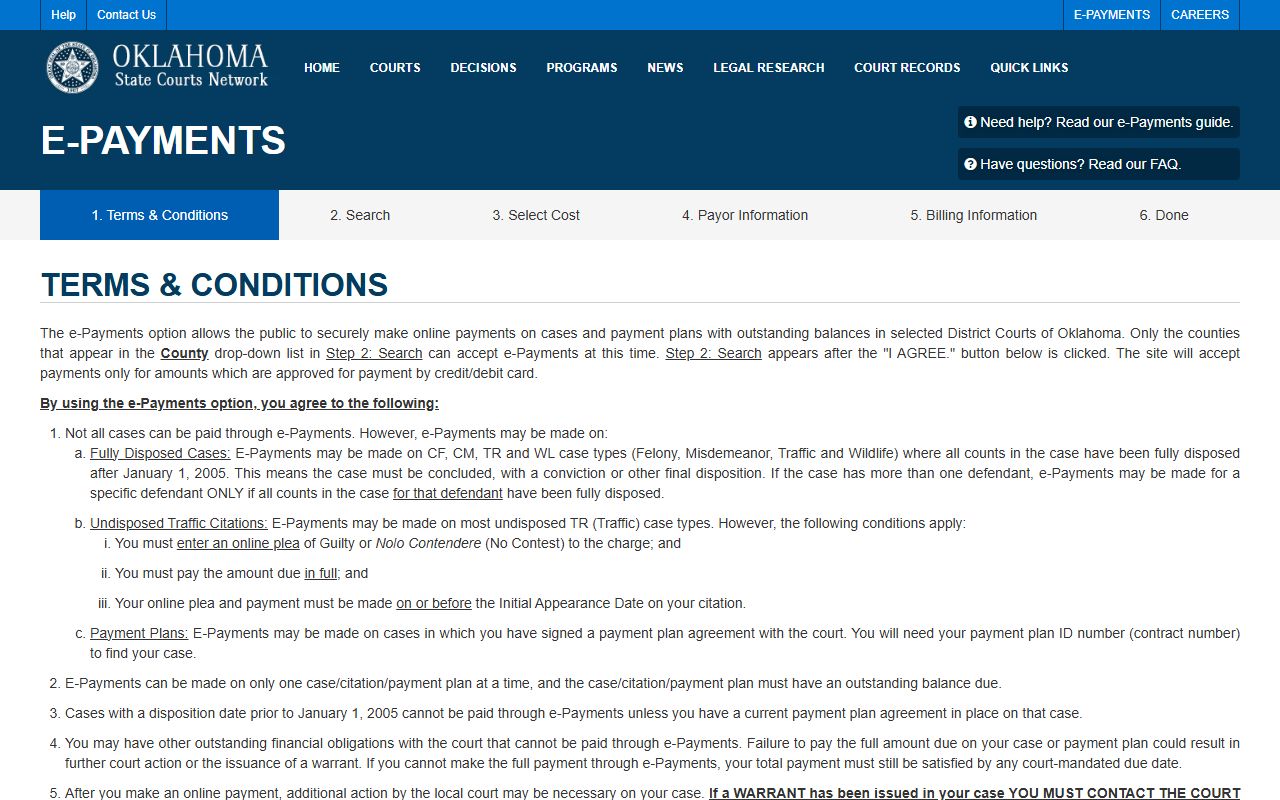
The same terms carry a warning that matters most for anyone with a warrant. If a warrant has issued on the case, an online payment does not recall it on its own, and the driver must contact the Court Clerk after paying.
Important: A failure to appear can trigger a bench warrant and a forfeited bond. Online payment alone does not clear a warrant, so call the Harmon County Court Clerk at 580-688-3617 to confirm the case and the warrant status.
- Identify whether the ticket is a Harmon County District Court citation or a City of Hollis municipal ticket.
- For a District Court case, search ODCR or OSCN by case, citation, or party name to confirm the charge and the amount owed.
- To pay online, read the eligibility rules first, since an undisposed citation may require a guilty or nolo plea and full payment before the appearance date.
- If a warrant exists, call the Court Clerk after payment because the online payment does not recall it.
- To contest the ticket, appear or contact the court before the appearance date, and do not pay online if that payment would enter an unwanted plea.
- For a municipal ticket, contact the City of Hollis municipal court or city clerk, since the Chapter 13 process is separate from the District Court systems.
Hollis Municipal Traffic Violations Bureau
City tickets in Hollis follow a separate path. Chapter 13 of the Hollis Code creates the municipal court, gives it original jurisdiction over ordinance violations, and names the City Clerk or a deputy as Clerk of the Court. Inside that office sits the Traffic Violations Bureau, a division that lets a driver pay certain tickets without a court appearance.
Not every ticket qualifies for the bureau. Under the ordinance text, a citation can be paid through the bureau only if it is not a second traffic offense within 12 months, not a driver license offense, and not punishable by a fine above the amount the ordinance sets. Tickets that fall outside those limits go to arraignment instead. A failure to appear in the municipal court can lead to a warrant and bond forfeiture, just as on the state side.
The City of Hollis posts its Chapter 13 municipal court ordinance, which lays out the bureau, the warrant rules, and the cost structure.
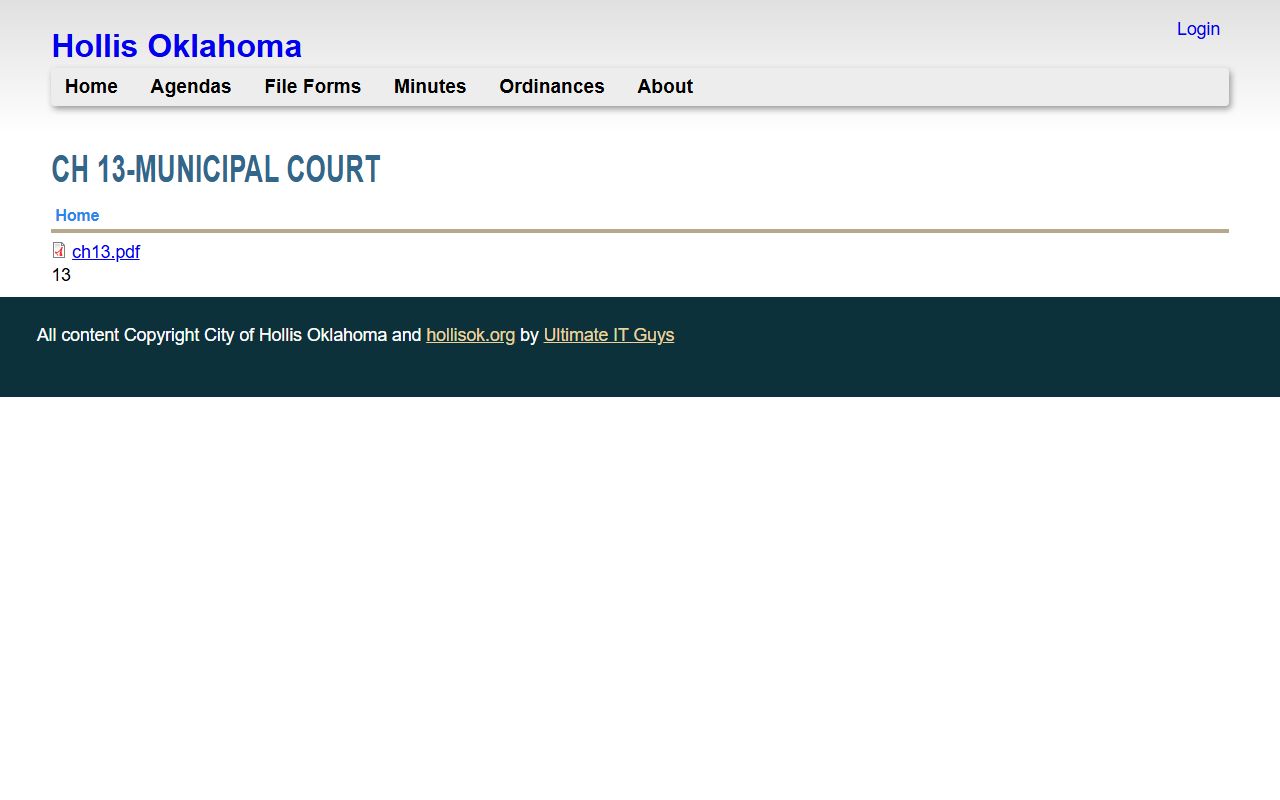
Because the ordinance fines and costs may have been amended over the years, the safe move is to confirm the current municipal amount and bureau eligibility with the city clerk before paying a Hollis ticket.
Public Access Laws for Traffic Court Records
Traffic court records are public in Oklahoma unless a statute or court order makes them confidential. The Oklahoma Open Records Act sets the baseline, and a separate rule shapes which personal details appear online. A driver record held by the state follows its own access law and stays apart from the court file.
Key Statutes:
Oklahoma Open Records Act, 51 O.S. §§ 24A.1-24A.33 - public bodies must give access to public records unless a statute or court order makes them confidential.
Oklahoma Court of Criminal Appeals Rule 2.6 - online court records are a public-search aid, but protected identifiers may be kept out of internet view.
Court Traffic Records vs State Driver Records
This is the distinction drivers miss most. The court traffic record is the case file for one citation, kept by the court. The state driver record, or MVR, is a separate file kept by Service Oklahoma that summarizes a person's driving history. Fixing an error on one does not fix the other, and they are requested in different places.
| Point | Court Traffic Record | State Driver Record |
|---|---|---|
| Record source | Harmon County District Court / Court Clerk | Service Oklahoma |
| What is in it | Citation or case number, charge, statute or ordinance, court date, plea, disposition, fines, costs, warrants, payment plan | Three-year driving record summary, driver and license identifying information, convictions and traffic history as the state keeps it |
| Where to access | ODCR or OSCN online, or the Court Clerk in person | Service Oklahoma online, in person, or by mail |
| How to correct errors | Raise it with the court that holds the case through the Court Clerk | Work through Service Oklahoma, since the MVR reflects the state record, not the court docket |
Service Oklahoma Driver Records and MVR Requests
A state driving record comes from Service Oklahoma, not the Court Clerk. Form 303RM-M is the request, and the summary it produces is limited by law to three years. By law, a person may request their own record, while a third party needs statutory authority or the driver's consent. The form can be filed online, in person at a licensed operator, or by mail to Service Oklahoma, ATTN: Business Support Services/Records, PO Box 11415, Oklahoma City, OK 73136-0415.
Service Oklahoma runs an individual motor vehicle report request for a driver pulling their own record online.
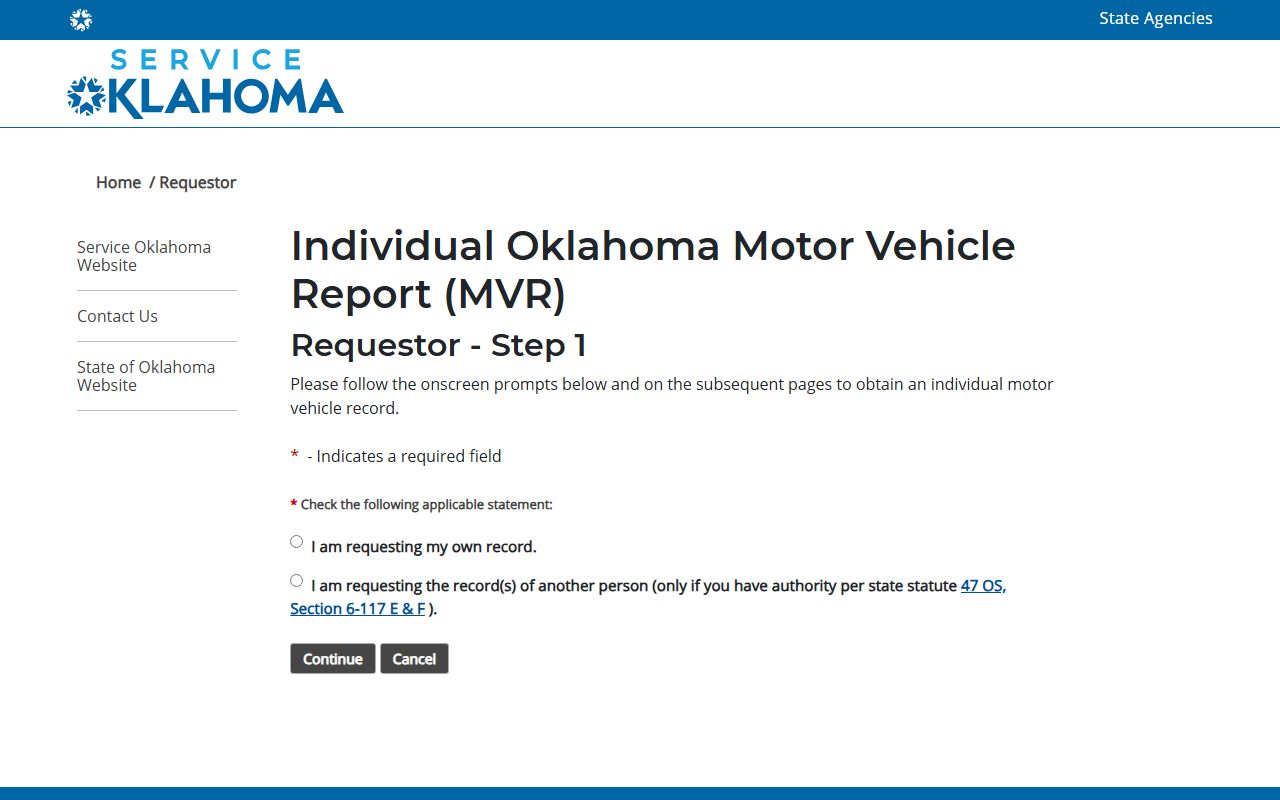
The online tool mirrors the paper form, so a Harmon County driver can get the same three-year summary without mailing anything. The fields below show what the request asks for.
| Field | Type | Required | Notes / Format |
|---|---|---|---|
| Oklahoma Driving Record Summary | Item | Yes | $25; certified copy adds $3. |
| This report is for yourself | Radio | Yes | Yes or No selection. |
| Driver name, license number, sex, date of birth | Text | Yes | Identifies the driver whose record is pulled. |
| Requestor name and contact | Text | Yes | Mailing address, city, state, zip, phone, and email. |
| Reason for request | Checkbox | Conditional | Government, legal, insurance, CDL employer, driver consent, and other listed purposes. |
| Driver signature | Signature | Conditional | Required when consent is the access basis. |
| Requestor signature | Signature | Yes | Affirmation under penalty of perjury. |
| Return records via | Checkbox | Yes | Requestor mailing address or email address. |
CDL and Commercial Driver Records
Commercial drivers face tighter rules. A violation tied to a commercial driver license can affect a livelihood, and federal reporting standards mean these offenses follow the driver across states. A CDL holder should treat a traffic citation as a record matter, not just a fine to clear.
Because a conviction can reach the driving record and any CDL employer reason for an MVR request, a commercial driver may want the case reviewed before entering a quick plea. The Court Clerk can confirm the case status, and the state driving record shows how a disposition is reflected on the license file.
DUI and DWI Cases
Driving under the influence is not a routine traffic ticket. In Oklahoma, a DUI or DWI is charged on the criminal side of the District Court, so it carries arraignment, possible bond, and a full case file rather than a simple bureau payment. The traffic search may still show a related case number, but the substance lives in the criminal record.
For the full case file, charges, and any sentence, see the Harmon County criminal court records overview.
Deferred Sentences, Defensive Driving, and Clearing a Record
Oklahoma uses a deferred sentence to delay disposition while a defendant meets conditions, which can lead to a dismissal. On a traffic case, that path may keep a conviction off the record if the terms are met. Eligibility and any course requirement are decided by the court, so the Court Clerk can give filing access while the judge or prosecutor sets the terms.
Clearing an old record runs on two tracks. A Section 991(c) expungement updates a deferred case to show a not-guilty plea and dismissal, but it does not erase an arrest record. A Section 18 expungement can seal the wider record for people who qualify. Expunging the court record is free, while sealing an arrest record carries a $150 OSBI processing fee. Because eligibility is fact-specific, a person files in District Court and uses the resulting order with the agencies that hold the record.
Note: A traffic conviction already reflected on the state driving record stays on that file under its own three-year summary rule, separate from any court-record expungement.
Fees for Traffic Record Copies
Two kinds of copy fees come up with traffic records. The state driving record has a published price. The Harmon County court-copy fees are set by Oklahoma law but were not posted on a Harmon-specific page, so confirm them with the Court Clerk before mailing a request. The Harmon County Court Clerk also confirms current certification and traffic-payment amounts.
| Item | Amount |
|---|---|
| State driving record (MVR) | $25 |
| Certified state driving record | $28 |
| Court plain copy per page | Not published; verify with the Court Clerk |
| Court certified copy | Not published; verify with the Court Clerk |
Before sending payment to the courthouse, call ahead. Harmon-specific mailing and payment instructions were not published, and rural staff capacity can be limited. A quick call to 580-688-3617 confirms the cost and the method.