
Criminal Court Records in Harmon County
A criminal court record is the case file the Court Clerk opens the moment the District Attorney files charges. It is not the arrest report from the jail. It is the court's own running account of the case: the charging document, the dates of each hearing, every motion and order, the plea, the verdict or settlement, and the sentence. The Harmon County Court Clerk, Stacy Macias, keeps these files at the courthouse at 114 W. Hollis in Hollis. Each case carries a number such as CF for a felony, CM for a misdemeanor, or TR for a traffic matter filed in District Court.
The Harmon County District Court is the trial court that hears these cases. It is a court of general jurisdiction, so both felony and misdemeanor charges move through the same courthouse. Felonies are the serious charges and begin with a preliminary hearing, where a judge decides whether the evidence is strong enough to send the case forward. Misdemeanors are lesser offenses and skip that step. Harmon County sits in Oklahoma Judicial District 3 with Greer, Jackson, Kiowa, and Tillman counties, and the District Attorney for that district prosecutes the state's criminal charges here.
How to Search Harmon County Criminal Court Records
Two free public systems carry Harmon County criminal cases. On Demand Court Records, known as ODCR, lists Harmon County as a participating court with records back to August 3, 2002 and hourly updates. The Oklahoma State Courts Network, OSCN, also indexes Harmon County District Court and is best when you already know the case number.
- Open the ODCR search page and pick Oklahoma District Courts, then choose Harmon to narrow the search to this county.
- Search by defendant name in Last, First format, or enter a full case number if you have one.
- Filter by case type to separate Criminal Felony Proceedings and Criminal Misdemeanor Proceedings from civil, traffic, and family cases, and add a filing-date range to trim the results.
- Open the matching case to read the docket entries, the charges and counts, the assigned judge, and the disposition.
- Request a certified copy from the Court Clerk at 580-688-3617 when you need an official document, an older file, or a record that is not posted online.
OSCN warns that its online data is a search aid, not the official record. For a statewide criminal history check across counties, the same name may appear in other Oklahoma district courts, so a broad ODCR search using All Courts can surface cases filed outside Harmon County.
Stages of a Criminal Case
A criminal case leaves a trail in the record at each step. Knowing the order of those steps makes the docket far easier to read, because each entry maps to a stage. A felony adds one stage that a misdemeanor does not have: the preliminary hearing, where the state must show probable cause before the case is bound over for trial.
Case flow: Charges Filed › Arraignment › Pretrial / Motions › Plea or Trial › Disposition › Sentencing
| Stage | What Happens |
|---|---|
| Charges Filed | The District Attorney files an information or complaint that lists each count, the statute, and the offense date. This opens the case file. |
| Arraignment | The defendant is read the charges and enters a plea. Bond and the next court date are set and noted in the docket. |
| Preliminary Hearing | For felonies only, a judge weighs the evidence and decides whether to bind the case over for trial. |
| Pretrial / Motions | Lawyers file written requests, exchange evidence, and argue motions. Continuances and rulings appear as docket entries. |
| Plea or Trial | The case ends in a plea agreement or goes to trial before a judge or jury. The result is recorded as a verdict or a plea. |
| Sentencing | The court sets the penalty: jail or prison time, fines and costs, probation, restitution, or a deferred or suspended sentence. |
Court-appointed defense for those who cannot afford a lawyer comes through the Oklahoma Indigent Defense System. Its regional non-capital trial office in Altus, at 123 W. Commerce St., Suite 100, phone 580-782-2429, covers Harmon County, so a defense attorney often appears in the docket from the arraignment forward.
What a Harmon County Criminal Court Record Shows
The public case file pulls together a fixed set of fields. ODCR and OSCN display most of them in the case detail, and the Court Clerk's paper file holds the rest. Reading them in order gives a clear picture of who was charged, with what, and how the case ended.
| Field | What It Shows |
|---|---|
| Case Number | The prefix, year, and number, such as CF for a felony or CM for a misdemeanor, that identifies the file. |
| Caption | The style of the case, written as State of Oklahoma versus the named defendant. |
| Defendant | The person charged, sometimes with party role, attorney, and the law-enforcement agency that made the arrest. |
| Charges | Each count, the statute allegedly violated, the classification, and the offense date. |
| Judge and District Attorney | The assigned judicial officer and the prosecutor handling the case. |
| Docket Entries | A dated list of filings, hearings, motions, and orders with short text for each event. |
| Plea | The defendant's answer to each count: guilty, not guilty, or no contest. |
| Disposition | The outcome of each count, such as conviction, dismissal, acquittal, or deferred disposition. |
| Sentence | The penalty imposed, including custody time, probation, fines, costs, and restitution. |
| Financial Fields | Amount owed, bond, receipts, and any payment plan tied to the case. |
For a closer look at the charges themselves, how they are filed, amended, reduced, or dropped, the Harmon County arrest and court charge records page breaks down the charging side in detail. Note: online dockets may omit documents that are sealed, not digitized, or withheld from internet view, so the clerk's file is always the fuller record.
Charges vs. Convictions
Being charged is not the same as being convicted. A criminal court record can show counts that were dropped, dismissed, or that ended in an acquittal, and those outcomes carry very different weight than a conviction. The charge listed at the jail after an arrest may also differ from the count the District Attorney finally files, since prosecutors review the evidence and can amend or decline charges.
| Charge | Conviction | |
|---|---|---|
| Stage | Accusation at filing | Verdict or guilty plea |
| Who Decides | District Attorney | Judge or jury |
| Burden of Proof | Probable cause | Beyond a reasonable doubt |
| Possible Outcome | Dropped, dismissed, or amended | Sentence imposed |
| Public Record | Yes | Yes |
Both charges and convictions stay in the public case file unless the record is later sealed. That is why reading the disposition for each count matters as much as reading the charge.
Reading Dispositions and Sentences
The disposition is the line that tells you how a count ended. A single case can hold several dispositions, one for each count, and they do not always match. One charge may be dismissed while another ends in a guilty plea.
- Guilty plea: the defendant admits the charge and the count resolves as a conviction.
- Not guilty / acquittal: the state did not prove the count, and it does not become a conviction.
- Nolo contendere: a no-contest plea that resolves the count without admitting guilt.
- Dismissed: the count is dropped, with prejudice if it cannot be refiled or without prejudice if it can.
- Deferred sentence: a delayed disposition that can end in dismissal once the defendant meets the court's conditions.
- Suspended sentence: a sentence the defendant does not serve in custody as long as conditions are met.
The sentence sits next to the disposition. It can combine custody time, fines, court costs, probation, and restitution. A deferred or suspended sentence still leaves a record, even though it keeps the defendant out of prison, so the docket and the sentence line should be read together.
Sealed vs. Expunged Records
Oklahoma offers two very different ways to clean up a criminal record, and people often confuse them. The Oklahoma State Bureau of Investigation explains the split clearly. A Section 991(c) action cleans up the court record after a deferred sentence, while a Section 18 expungement can seal the entire arrest record for those who qualify. One updates the case; the other reaches the arrest history held by the state.
| Section 991(c) Cleanup | Section 18 Expungement | |
|---|---|---|
| What It Does | Updates the disposition to a not-guilty plea and dismissal | Seals the full arrest and court record from public view |
| Arrest Record | Stays on file, not removed | Removed from public access |
| Cost | Free | $150 OSBI processing fee, plus possible local fees |
| Where It Starts | Harmon County District Court | District Court order used with OSBI and local agencies |
Eligibility for either path is fact-specific. The Court Clerk can give a person filing access and the case number, but the office cannot offer legal advice. Details on the process appear on the OSBI criminal-history expungement page.
Public Access to Criminal Court Records
Court records in Oklahoma are public unless a statute or court order makes them confidential. That means most Harmon County criminal case files are open to anyone, online or at the clerk's counter. The online systems are convenient, but the Court Clerk holds the official file, and certified copies for legal use must come from that office. For a wider view of every record the courthouse keeps, the Harmon County court records overview covers civil, family, probate, and traffic files alongside criminal cases.
Online filings follow a separate rule that limits which personal details appear on the internet. The Oklahoma Court of Criminal Appeals sets that limit, and the courts post a public version of the rule for anyone to read.
The Oklahoma Court of Criminal Appeals publishes Rule 2.6 on internet access and personal identifiers, which shapes what a Harmon County criminal court record shows online.
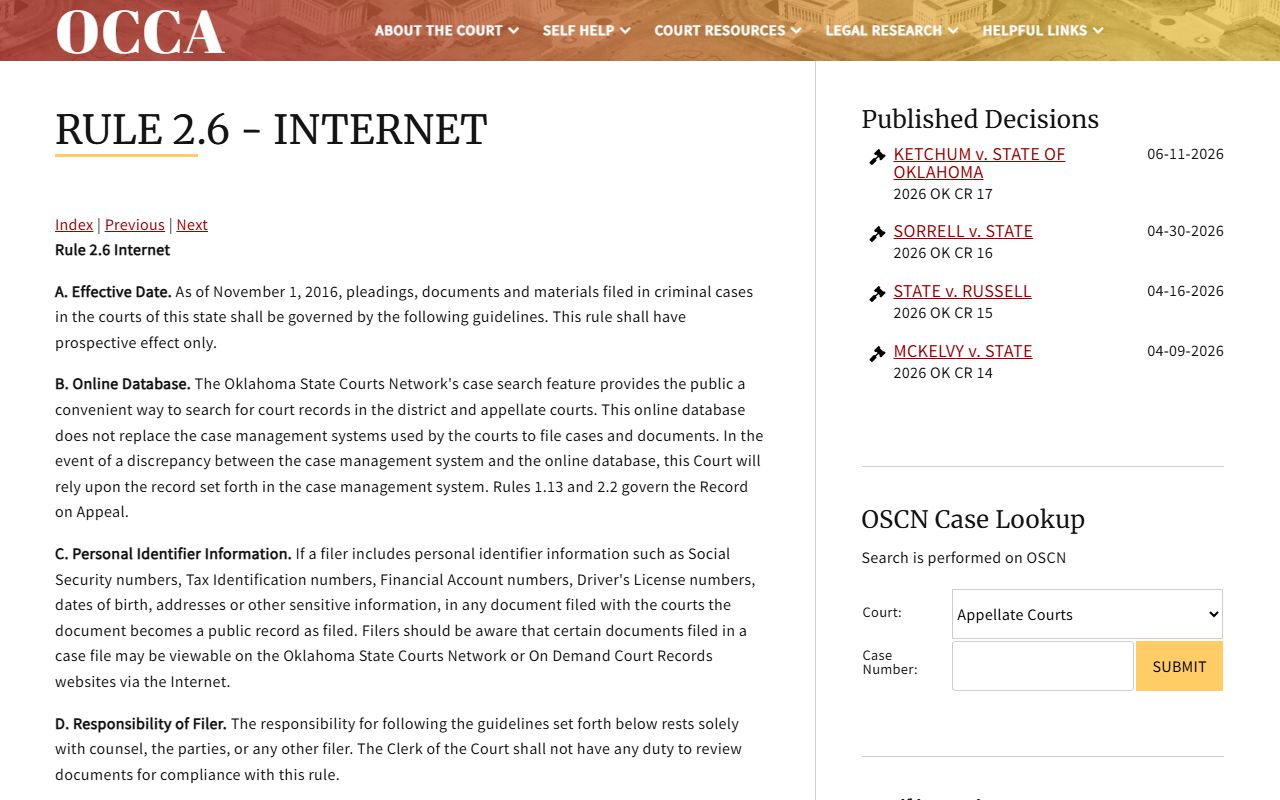
Rule 2.6 directs filers to limit Social Security numbers, financial account numbers, driver's license numbers, and dates of birth in public filings, and it keeps certain protected materials out of internet view. The result is that the online docket may show less than the paper file the clerk holds.
Key Statutes:
Oklahoma Open Records Act, 51 O.S. §§ 24A.1-24A.33 - public bodies must provide access to public records unless a statute or court order makes the record confidential.
Court records public-status rule, 51 O.S. § 24A.30 - court records are public unless sealed or made confidential by law, and any sealing must be narrowly justified.
Criminal expungement, 22 O.S. §§ 18 and 19 - qualifying people may seek court and arrest-record expungement, with a $150 OSBI fee for arrest-record processing.
Who the Record Names in a Criminal Case
A criminal case file lists the offices that drive it. The District Attorney for District 3, Dan Jacobsma, files and prosecutes the state's charges, with the Harmon County office at the courthouse reachable at 580-688-9459. Assistant District Attorney Kelissa Sanders is listed at the same line. The charges the District Attorney files in District Court are the ones that count as the court charge record, not the preliminary charge entered at the jail.
On the other side, a defendant either hires counsel or, if indigent, receives a lawyer through the Oklahoma Indigent Defense System. The District Court judge and the Court Clerk round out the named parties, and each appears in the docket as the case moves. Note: the booking charge on the jail roster can change once the District Attorney reviews the case, so the filed information is the better guide to what a defendant actually faces.
Restricted Criminal Court Records in Harmon County
Not every criminal matter is open to the public. Some categories are closed by law, and others are hidden only after a court orders it. Asking the Court Clerk is the right move when a record cannot be found online, because the file may exist but sit outside public view.
- Juvenile cases, which are generally confidential and open only to parties, attorneys, agencies, or those a court allows.
- Sealed and expunged cases, which drop off the public docket or show only limited information after a qualifying order.
- Mental health proceedings, which are restricted because of medical and personal privacy.
- Personal identifiers such as Social Security and account numbers, which are withheld from internet-viewable filings.
For an active warrant tied to a criminal case, or to confirm whether a defendant is in custody, the docket points to other tools, but the clerk and the sheriff remain the official sources for that status.